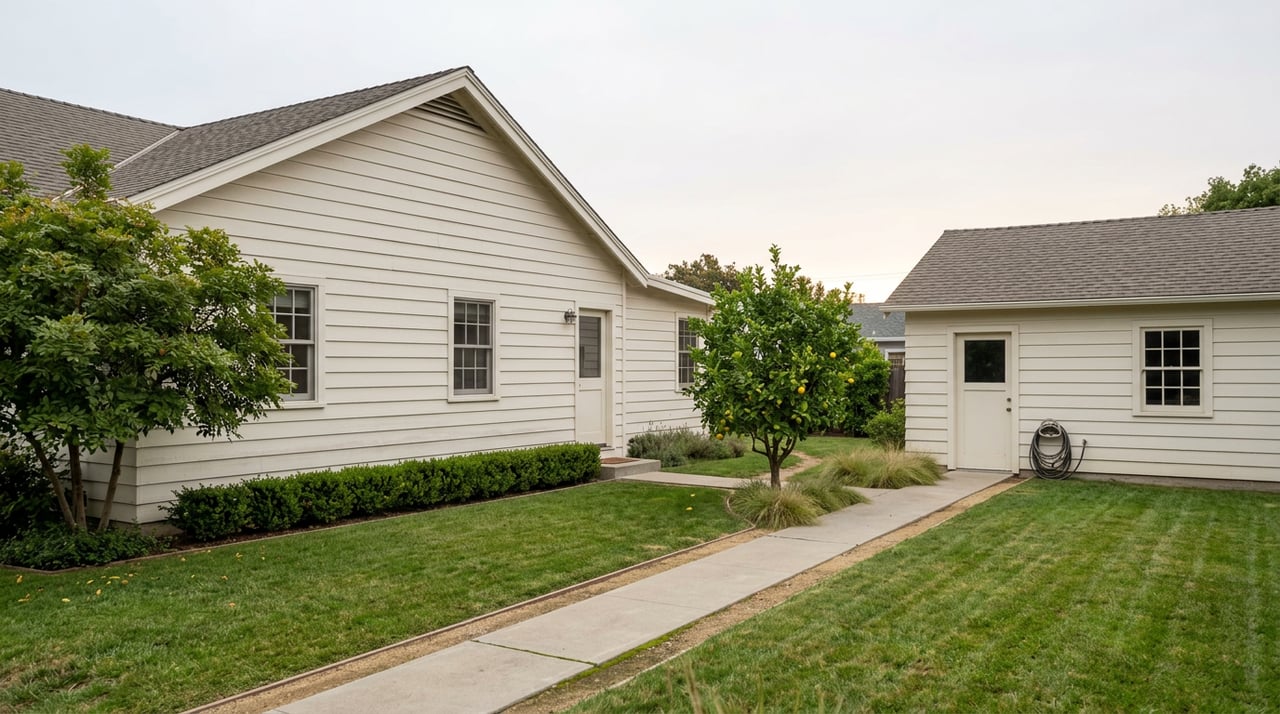
Walk any block along Kroy Way or 62nd Street and you will notice the same layout over and over: a modest bungalow or California ranch up front, a detached garage set back at the rear of the lot. Most of these houses went up between the late 1920s and the 1950s, when a two-car garage was standard and a house in the 1,000 to 1,300 square foot range counted as a full house for a family. Over the decades, a fair number of those garages stopped being garages. Someone needed a bedroom for a growing household, a home office, a place for a parent to live close but separate. The conversion happened. The permit, more often than not, did not.
That gap between what got built and what got filed with the city is the single biggest wrinkle in selling a Tahoe Park bungalow right now, and it costs more to ignore than most sellers assume, because Tahoe Park's sales pool is small enough that losing even a slice of buyers actually shows up in the outcome. It is also, as of this year, cheaper to fix than it has been in a long time, thanks to a state law most sellers have not heard of yet.
The Buyer Pool Is Smaller Than It Looks
Only 10 homes sold in Tahoe Park in April 2026, down slightly from 11 the same month a year earlier, and a separate market tracker puts current active inventory at just 6 listings. In a pool that thin, screening out even a fraction of buyers changes who actually shows up to make an offer.
That is exactly what an unpermitted garage conversion does. Appraisers working conventional loans typically will not count unpermitted square footage as gross living area, and FHA and VA appraisers are required to flag it outright. Lenders then condition the loan on either removing the space or bringing it up to code before closing. Cash buyers do not care about any of this. Buyers using FHA or VA financing, who make up a meaningful share of demand for a starter-home neighborhood priced mostly between $400,000 and $600,000, are the ones who walk.
Ryan Lundquist, a certified appraiser who writes the Sacramento Appraisal Blog, documented exactly how this plays out on the ground in one Sacramento case: a non-permitted garage conversion sold for about $15,000, roughly 6 percent, less than comparable homes with an intact garage, and he had to lean on a decade-old arm's-length sale of that same property just to justify giving the space any value at all. His point still holds today. An appraiser can only credit a conversion if the market has actually paid for similar space nearby, and in a neighborhood where conversions are common but rarely tracked as separate sales, that comparable is hard to find.
A Hot Market Does Not Solve This
It is tempting to assume Tahoe Park's tight inventory bails sellers out of financing headaches. It does not, and the numbers show why. Over the three months ending April 2026, the neighborhood's median sale price ran $542,000, up 7.4 percent year over year, but average days on market moved from 6 to 13 over that same stretch. A separate site's current tracking puts the median closer to $500,000, essentially flat year over year. Two trackers, two different pictures of the same handful of blocks. That disagreement is not a data error. It is what happens when a neighborhood sells 10 or 11 homes in a given month. Every individual sale swings the average.
A market that thin does not absorb financing friction the way a deeper suburban market does. If your buyer pool narrows from eight realistic offers to three because a lender's appraiser flagged unpermitted square footage, that is a much bigger hit here than it would be somewhere selling 40 homes a month. Speed of sale and price resilience at the neighborhood level do not protect an individual seller whose specific house carries a specific paper trail problem.
What Actually Counts as an ADU Here
Not every converted garage is treated the same way under California law, and the distinction shapes what comes next. If the old garage became a bedroom or den with an entrance shared through the main house, no kitchen, no separate address, it counts as a room addition, not an accessory dwelling unit. If it became a self-contained unit with its own kitchen and bathroom, functioning as a rentable in-law suite, it qualifies as an ADU or JADU under state law.
Tahoe Park's lot sizes make this distinction sharper than it would be in a newer subdivision. A Sacramento ADU permitting guide lists Tahoe Park among the city's neighborhoods, alongside East Sacramento, Land Park, Curtis Park, and Pocket-Greenhaven, where narrower setbacks and mature trees on older lots routinely trigger extra tree protection review during permitting. That review adds time and cost to a full, ground-up permit application, which is part of why so many owners here converted first and asked forgiveness later, if they asked at all. It also tracks with reporting that names Tahoe Park among the older Sacramento neighborhoods with the highest concentration of ADU activity in the city.
The 2026 Shortcut
This is where the math changed. A relatively new state provision known as AB 2533 gives owners of an unpermitted ADU or JADU built before January 1, 2020, a path to legalize it using a focused health and safety checklist, covering exits, smoke alarms, sanitation, structure, electrical, and plumbing, instead of forcing the whole structure through a full current-code retrofit. For a neighborhood built almost entirely before 2020 by definition, that cutoff date covers nearly every conversion sitting behind a Tahoe Park bungalow.
The City of Sacramento's ADU Resource Center is the place to start confirming whether a specific unit qualifies and what the checklist requires. For a seller sitting on a converted garage that actually functions as a second unit, running that checklist before listing is a meaningfully smaller lift than it used to be, when the only route was a full retrofit that could mean permitting costs stacking on top of construction costs on top of resolving the very setback issues those mature trees created in the first place.
If your conversion is just a bedroom, not an independent unit, this shortcut does not apply. That situation still runs through the standard retroactive permit process, which does mean full plan review.
| Disclose and sell as-is | Legalize first, where it qualifies | |
|---|---|---|
| Who buys | Cash buyers, investors, some conventional buyers at a discount | Full buyer pool, including FHA and VA |
| Rough price impact | Unpermitted work commonly reduces value by roughly 5 to 20 percent | None specific to permit status once legalized |
| Timeline | Fastest path to close | Adds weeks to months before listing |
| Best fit | Sellers prioritizing speed over top dollar | Sellers with a qualifying ADU and time before listing |
Timing It Right for a Fall Listing
If you are weighing this ahead of a listing this fall, the order of operations matters as much as the decision itself. California law requires disclosing known unpermitted work on the Transfer Disclosure Statement before a buyer's offer is accepted, not after. Sellers who wait until escrow to reveal it are the ones who watch a deal get renegotiated from a weaker position during the buyer's inspection period, or worse, face a rescinded offer within days of disclosure.
Decide first, disclose early, and price accordingly. That order keeps a Tahoe Park sale on track whether you land on legalize-first or sell-as-is. None of this changes what makes the neighborhood worth buying into. As one Coldwell Banker Realty agent who has worked Tahoe Park for years puts it, "Tahoe Park has an incredible location, great lots, classic homes and reasonable price points." The Saturday morning line at Bacon & Butter, the neighborhood association's warm-weather gatherings at the park, the short hop to Aggie Square that keeps rental demand steady a mile away, all of that still sells the house. It just means the paperwork on your specific garage needs to be settled before any of that context can do its job in your listing.
A short FAQ
Does every unpermitted garage conversion in Tahoe Park qualify for the AB 2533 shortcut? No. The checklist path applies specifically to accessory dwelling units and junior accessory dwelling units built before January 1, 2020. A converted garage used only as an extra bedroom, without its own kitchen and bath, does not meet the ADU definition and follows the standard retroactive permit process instead.
Will a legalized conversion actually add value once it's permitted? It depends on whether the market has paid for similar permitted space nearby, which is exactly what a qualified appraiser has to verify. A properly documented, code-compliant unit generally supports its added square footage far better than one still flagged as unpermitted, but the increase is not automatic.
Should I disclose an unpermitted conversion even if I did not build it myself? Yes. California disclosure law does not exempt a seller who inherited the condition rather than causing it. If you know about it, it belongs on the Transfer Disclosure Statement.
If you are trying to figure out whether your Tahoe Park garage conversion qualifies for the new legalization path, or what it is worth to a buyer either way, Lisa Rayman has walked Sacramento sellers through exactly this kind of paperwork problem for years. Reach out for a free home valuation and build consultation before you put the sign in the yard.